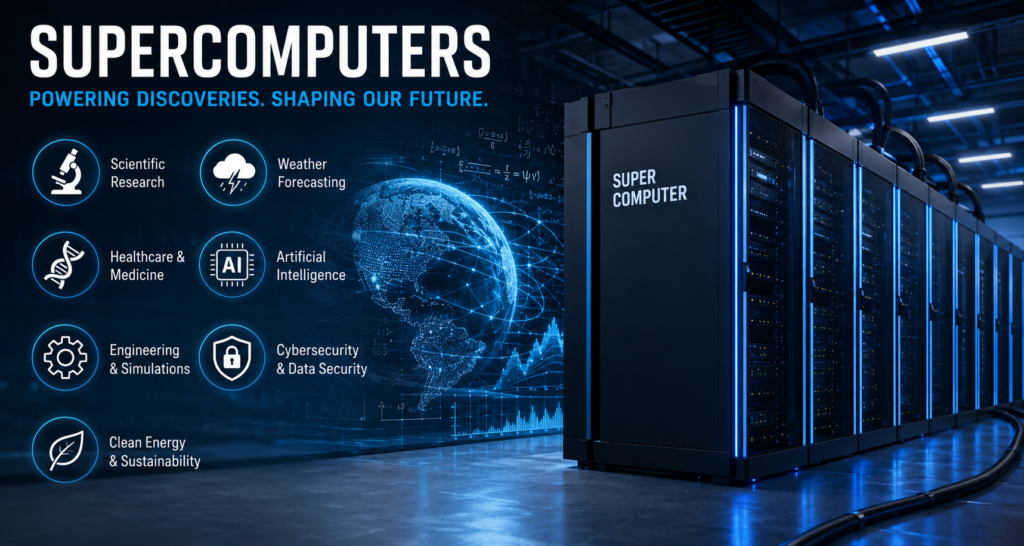
Supercomputers are among the most powerful machines ever created. They can process huge amounts of data and perform complex calculations at incredible speeds. These systems play an important role in science, medicine, weather forecasting, artificial intelligence, and many other fields.
While an ordinary computer is designed for daily tasks such as web browsing, office work, and gaming, a supercomputer is built to solve problems that would take years or even decades on a standard machine.
What is a supercomputer?
A supercomputer is a high-performance computer that can perform billions or even trillions of calculations every second. Instead of relying on a single processor, it uses thousands of processors working together at the same time.
These machines are usually housed in large data centres and can fill entire rooms. Their main purpose is to handle difficult tasks that require massive computing power.
How does a supercomputer work?
A supercomputer uses a method called parallel computing. Instead of solving a problem one step at a time, it divides the work into many smaller parts and processes them simultaneously.
Thousands of connected computers, known as nodes, work together as a single system. These nodes communicate through extremely fast networks, allowing them to share data quickly and efficiently.
Many modern supercomputers also use graphics processing units (GPUs). These components can perform large numbers of calculations at the same time, helping the system complete tasks much faster.
Software used on supercomputers is specially designed to spread workloads across thousands of processor cores. This allows the machine to make full use of its hardware power.
Main characteristics of a supercomputer
Supercomputers stand out because of several important features:
Massive processing power
Their performance is measured in FLOPS, which stands for floating-point operations per second. The most powerful systems can perform quadrillions of calculations every second.
Parallel architecture
Thousands of processors work together to complete tasks quickly and efficiently.
Advanced hardware
Supercomputers use powerful CPUs, GPUs, and large amounts of memory to handle demanding workloads.
High-speed communication
Ultra-fast internal networks allow different parts of the system to exchange information in real time.
Large physical size
These systems often require hundreds of cabinets and advanced cooling equipment.
Scalability
New hardware can be added as computing needs grow, allowing the system to expand over time.
What are supercomputers used for?
Supercomputers support many important industries and research projects around the world.
Scientific research
Scientists use supercomputers to study space, physics, chemistry, and other complex subjects.
Weather forecasting
Meteorologists analyse huge amounts of environmental data to predict storms, hurricanes, and climate changes.
Healthcare and medicine
Researchers use these systems to study diseases, develop medicines, and analyse genetic information.
Artificial intelligence
Supercomputers help train advanced AI models by processing massive datasets in a short time.
Engineering
Companies use simulations to improve vehicle designs, test products, and study airflow and materials.
Energy exploration
Oil, gas, and mining companies analyse geological data to locate valuable resources underground.
Cybersecurity
Security experts test and strengthen digital protection systems using advanced computing power.
Advantages of supercomputers
Supercomputers offer many benefits.
Exceptional speed
They can complete calculations in hours that would take ordinary computers months or years.
Large-scale data processing
These systems can manage and analyse enormous amounts of information.
Advanced simulations
Researchers can safely test ideas and models without conducting expensive real-world experiments.
Shared access
Many organisations can rent supercomputer resources through cloud services, reducing costs.
Disadvantages of supercomputers
Despite their power, supercomputers also have limitations.
High cost
Building and maintaining a supercomputer requires a huge financial investment.
Heavy power consumption
These systems use large amounts of electricity and can be expensive to operate.
Cooling requirements
Thousands of processors generate significant heat, requiring advanced cooling systems.
Complex maintenance
Highly skilled engineers are needed to manage and maintain the hardware and software.
Large space requirements
Supercomputers often occupy dedicated facilities with specialised infrastructure.
How much does a supercomputer cost?
The cost of a supercomputer can range from hundreds of millions to several billions of dollars. The final price depends on the hardware, storage capacity, cooling systems, and networking technology used.
Operating costs are also significant. Electricity bills alone can reach millions of dollars each year. Because of these expenses, many organisations choose to rent computing power through cloud services instead of purchasing their own systems.
Supercomputer vs quantum computer
Although both technologies are powerful, they work in very different ways.
A supercomputer uses traditional binary bits that represent either 0 or 1. It achieves high performance by combining thousands of processors that work together.
A quantum computer uses qubits, which can represent both 0 and 1 at the same time through a concept known as superposition. This allows quantum computers to solve certain specialised problems much faster than traditional systems.
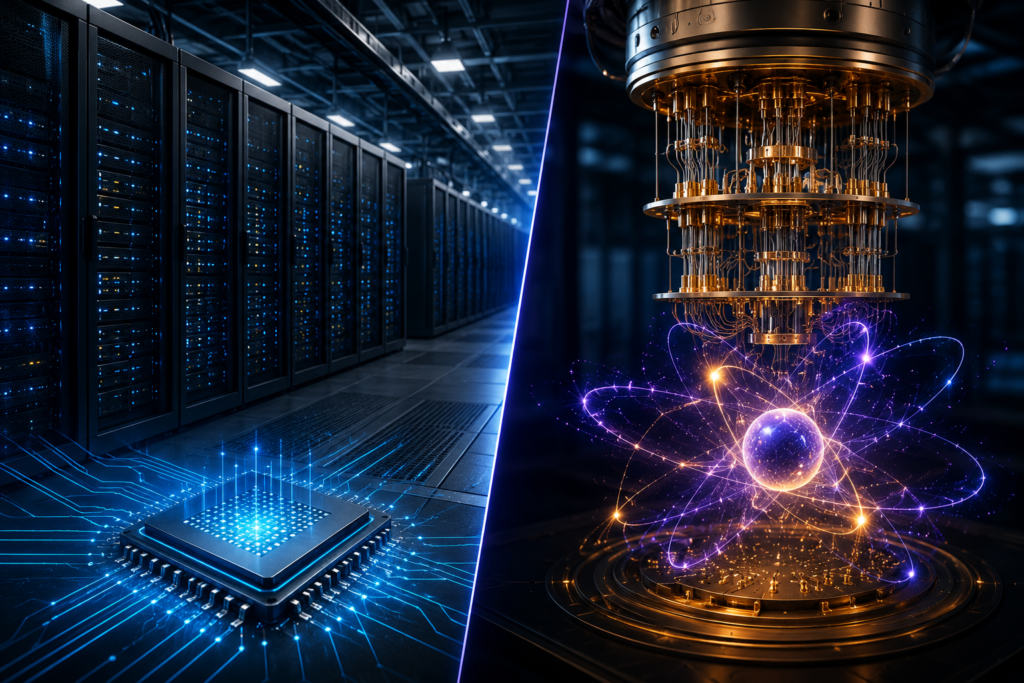
Today, supercomputers remain the practical choice for most large-scale scientific and industrial workloads, while quantum computing is still an emerging technology with limited real-world deployment.
Supercomputer vs mainframe
A supercomputer focuses on solving highly complex calculations and scientific problems as quickly as possible.
A mainframe focuses on reliability, security, and handling large numbers of users and transactions at the same time. Banks, governments, and large enterprises often use mainframes to process financial records and business data.
In simple terms, a supercomputer is built for speed and research, while a mainframe is built for stability and large-scale business operations.
Final thoughts
Supercomputers continue to drive innovation across science, healthcare, artificial intelligence, and engineering. Their ability to process huge amounts of data at incredible speeds helps researchers solve problems that would be impossible with ordinary computers.
As technology advances, supercomputers are expected to become even more powerful, supporting new discoveries and helping create smarter solutions for some of the world’s biggest challenges.