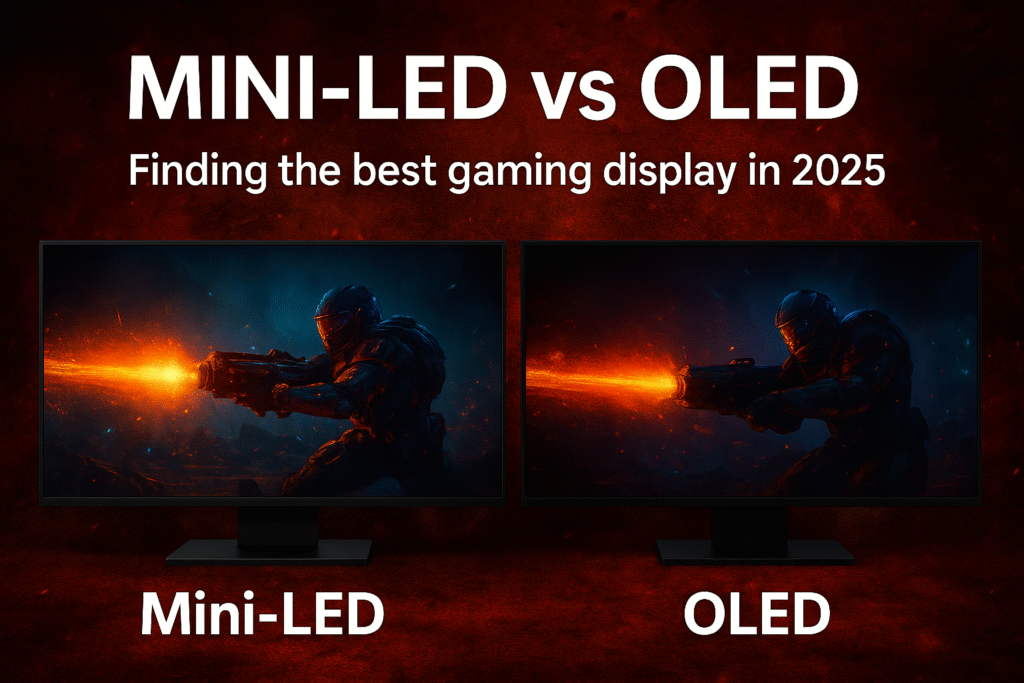
In 2025, one of the biggest questions for gamers buying a new monitor is simple Mini-LED vs OLED, which one is better? Both are amazing display technologies, offering stunning visuals and smooth performance, but they work differently and suit different needs.
This guide explains everything you should know about Mini-LED and OLED, how they compare for gaming, and which one gives you the best experience in 2025 and beyond.
What makes Mini-LED and OLED different?
The key difference between Mini-LED and OLED is how each creates light. OLED uses pixels that light up on their own, while Mini-LED relies on a grid of thousands of small LEDs behind an LCD panel.
OLED gives perfect control over each pixel’s brightness and colour, while Mini-LED uses local dimming zones to achieve high contrast and brightness. Both can look fantastic, but they have unique strengths depending on what you’re playing.
OLED: Sharp, fast, and full of contrast
OLED stands for Organic Light Emitting Diode. Every pixel in an OLED panel creates its own light, which means it can turn completely off to show true black. This gives OLED its famous “infinite contrast” and deep, cinematic look.
Because OLED pixels react instantly, motion looks clear and smooth, even in fast-paced games. Modern OLED panels come in two types:
- WOLED + MLA: Uses micro lenses to make the screen brighter without extra power.
- QD-OLED: Uses quantum dots to deliver pure red, green, and blue light for vibrant, natural colours.
For gamers who love beautiful visuals and smooth action, OLED offers an unmatched experience.
Mini-LED: Bright, durable, and reliable
Mini-LED is the latest step forward in LCD technology. Instead of using a few backlights, Mini-LED screens pack thousands of tiny LEDs into local dimming zones. These zones adjust brightness individually, giving stronger contrast and much higher brightness than older LCDs.
In 2025, high-end Mini-LED monitors have over 4,000 dimming zones and smarter algorithms that reduce the “halo” effect around bright objects. They can reach over 1500 nits of peak brightness — perfect for HDR gaming or bright rooms.
Mini-LED displays are also completely safe from burn-in, making them ideal for everyday gaming and productivity.
Mini-LED vs OLED: Gaming performance breakdown
Motion clarity and response:
OLED wins easily here. Its near-instant pixel response means no motion blur, giving an edge in competitive games.
HDR and brightness:
Mini-LED takes the lead in brightness. It stays bright across the whole screen, while OLED uses brightness limiters to protect the panel.
Contrast and black levels:
OLED is unbeatable in black levels and contrast, showing incredible depth and realism in dark scenes.
Burn-in and durability:
Mini-LED wins for long-term use. OLED panels can show burn-in if static images remain for hours, but newer OLEDs include pixel shifting and heat control to reduce this risk.
Colour performance:
Both look excellent. Mini-LEDs with Quantum Dot films show wide colour ranges, but QD-OLEDs still deliver slightly purer and richer colours.
Price and value:
Mini-LED monitors are usually more affordable. OLED screens still cost more due to complex production, but prices are slowly coming down.
Which one should you choose?
For esports and fast-action games:
Go with OLED. The instant response time and blur-free visuals are perfect for competitive gaming.
For cinematic and open-world titles:
OLED again offers a more immersive look thanks to its perfect blacks and contrast, ideal for games like Cyberpunk 2077 or Alan Wake 2.
For mixed gaming, work, and everyday use:
Choose Mini-LED. It’s bright, reliable, and safe from burn-in great for gaming, editing, and office work.
Final verdict
In the Mini-LED vs OLED debate, both are incredible technologies. OLED delivers the best picture quality, contrast, and motion clarity for pure gaming immersion. Mini-LED, meanwhile, is brighter, more durable, and a better all-round choice for gamers who also work or create content on their PCs.
Ultimately, your best choice depends on what matters most to you OLED for perfection in visuals, or Mini-LED for long-lasting brightness and value.